
Blog
What Is a Mesh Coil? How Coil Design Affects Vape Flavour

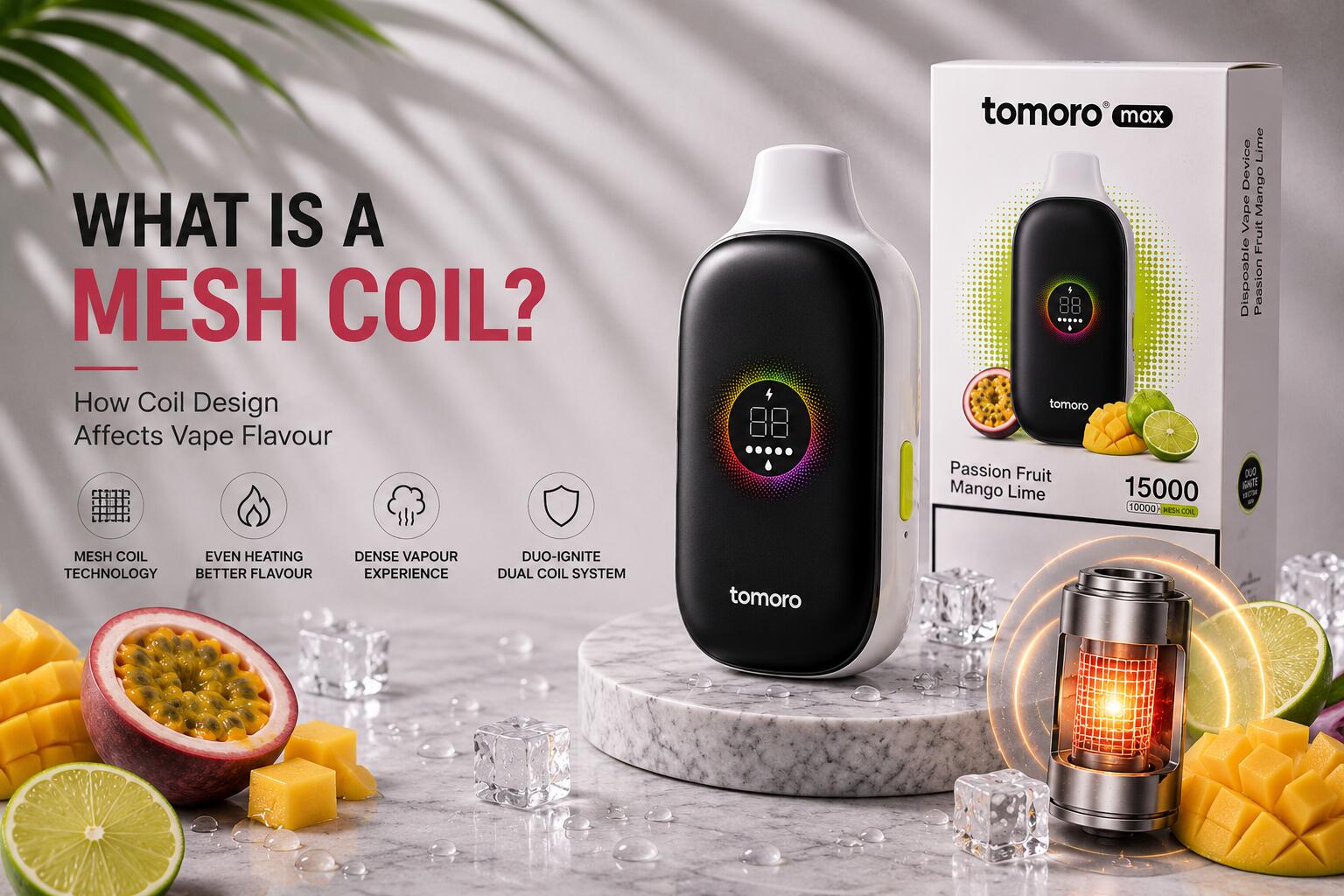
Last Updated on September 2, 2026 by Digital
When people compare vape flavours, most of the attention goes to the e-liquid itself. Is it fruity or icy? Sweet or sharp? Simple or layered?
But the flavour in the liquid is only part of what you eventually taste.
Before that flavour reaches you, the e-liquid has to be heated and turned into vapour — and the coil is responsible for doing that job. Its shape, surface area and the way it distributes heat can all influence how a flavour comes through.
That is one reason mesh coils have become so common in modern vape devices.
So, what exactly is a mesh coil, and why does its design matter?
What Is a Mesh Coil?
Despite the name, a mesh coil does not look much like the traditional coil you might imagine.
Older-style vape coils generally use a length of metal wire wound into a spiral. A mesh coil uses a thin piece of perforated metal with a grid-like structure instead.
Both designs have the same basic purpose: electricity passes through the metal, the metal heats up, and that heat vaporises the e-liquid held in the surrounding wick.
The important difference is how much surface area is being heated at once.
Because mesh spreads across a wider section of the wick than a thin wire, it can make contact with more e-liquid at the same time. It also distributes heat across a broader area rather than concentrating it around a few narrow points.
Mesh Coil vs Traditional Coil
The easiest way to understand the difference is to put the two designs side by side.
| Traditional Wire Coil | Mesh Coil | |
| Heating Element | Wound metal wire | Perforated metal mesh |
| Surface Area | Smaller | Larger |
| Heat Distribution | More concentrated | More evenly spread |
| Heating Response | Can take longer to reach temperature | Generally heats quickly |
| Flavour Delivery | Depends heavily on coil design | Often fuller and more consistent |
| Vapour Production | Generally more concentrated | Can produce denser vapour |
Neither design magically changes the flavour ingredients inside the e-liquid. What changes is how efficiently and evenly that liquid is heated.
Why Does Surface Area Matter for Flavour?
Imagine heating something in a pan.
If only one tiny part of the pan becomes extremely hot while the rest stays cooler, you are unlikely to get an even result. Spread that heat more evenly across the surface and the result becomes easier to control.
A similar principle applies inside a vape.
A mesh heating element sits against a larger area of the wick. When it heats, more of the e-liquid can be vaporised across that surface at the same time.
For flavour, this matters because a vape flavour is often made up of several notes rather than one.
Take a combination such as TOMORO Max 15000 Puffs Passionfruit Mango Lime. You have mango sweetness, sharper passionfruit and a citrus lime note working together. More consistent heating can help those different parts of the profile come through in a more balanced way rather than having the experience dominated by uneven heating.
That is why mesh coils are often associated with a fuller, more defined flavour delivery.
More Even Heat Can Mean a More Consistent Draw
Surface area is only half the story. Heat distribution matters too.
Traditional wound wire can develop areas that run hotter than others. These are often called hot spots.
If one small section becomes significantly hotter, it can put extra stress on the wick at that point. In more severe cases, the wick can begin to scorch, which is where that unpleasant burnt taste can come from.
A mesh structure spreads electrical current and heat across a wider area. That does not make burnt or dry hits impossible, but it can reduce the concentration of heat in one small spot when the system is operating correctly.
For the user, the difference is less about understanding electrical resistance and more about something simple: you want the next draw to taste reasonably similar to the last one.
Do Mesh Coils Produce More Vapour?
They can.
The same larger surface area that influences flavour can also vaporise a greater amount of e-liquid at once. That can result in denser vapour, depending on the coil resistance, power output, airflow and overall device design.
This is why it is slightly misleading to say that a mesh coil alone creates bigger clouds.
The coil is one part of a system.
Power matters. Airflow matters. E-liquid composition matters. Even the way you inhale matters.
A well-designed vape balances all of these rather than relying on the coil alone.
What About Dual Mesh Coils?
A dual-mesh system takes the idea a step further by incorporating two mesh heating elements rather than relying on a single heating surface.
Depending on how the device is engineered, this can give the manufacturer more flexibility in balancing vapour production, flavour delivery and different power levels.
There is a trade-off, though.
More active heating area and higher output can mean faster consumption of both battery power and e-liquid. This is particularly noticeable when a device offers a higher-power mode.
How Does the TOMORO Max Use Mesh Coil Technology?
The TOMORO Max 15000 uses a Dual Mesh coil rated at 1.1±0.1Ω, together with TOMORO’s Duo-Ignite dual-coil system.
The device operates at 10W in standard mode, with the option to move to 16W Boost Mode for a stronger output.
In everyday terms, the dual-mesh system is there to help the device balance flavour and vapour across those different power levels without requiring the user to manually change coils or adjust resistance.
Standard mode provides the more relaxed option, while Boost Mode increases the output for a warmer, denser draw.
You can read more about the difference in What Is Boost Mode on the TOMORO Max?
Does a Mesh Coil Make Every Flavour Taste Better?
Not automatically.
A mesh coil can influence how an e-liquid is vaporised, but it cannot fix a poorly balanced flavour.
Airflow, power output, e-liquid formulation, temperature and even personal taste still matter.
What mesh technology does offer is a larger and more evenly heated surface, giving the flavour formulation a more consistent platform to work from.
This can be particularly noticeable with layered profiles where several flavour notes are meant to appear together rather than one simple flavour dominating the draw.
If you are curious about how fruit, ice, tropical and mixed profiles differ, see our TOMORO Max Flavours Guide.
Final Thoughts
A mesh coil is ultimately a fairly simple idea: replace a narrow wound wire with a wider, grid-like heating surface.
That change gives the coil more contact with the wick and helps spread heat more evenly. In turn, it can contribute to faster heating, denser vapour and more consistent flavour delivery.
The flavour you actually experience comes from the relationship between the coil, e-liquid, airflow and power output. That is why coil design matters — not because it creates the flavour, but because it plays an important part in how that flavour reaches you.
